Live Hangout: PD Kickstarter #16: Travel Line Expansion
In the recent Live Hangout: PD Kickstarter #16: Travel Line Expansion, the Peak Design team, including Pete, Santi, Joey Cunningham, and Colin McGinnis, shared exciting insights about the company's evolution and product innovations. Celebrating Pete's 16th year at Peak Design, the session mixed humor with reflections on entrepreneurship and team camaraderie. This lively discussion also introduced new team members like Emma, the "Social Media Queen," and acknowledged veteran project manager Adrian.
Central to the hangout was the unveiling of Peak Design's latest travel line, launched via a Kickstarter campaign that quickly gained traction. The campaign attracted nearly 5,000 backers, demonstrating the community's enthusiasm for their thoughtfully designed bags. Emphasizing modularity and ease of travel, the new products continue Peak Design’s legacy of blending style with functionality, appealing to photographers and travelers alike.
Did You Know?
Peak Design's Kickstarter campaign attracted nearly 5,000 backers for their new travel bags, showcasing strong community support.
Source: Live Hangout: PD Kickstarter #16
Milestones and Reflections from the Team
During the Live Hangout: PD Kickstarter #16: Travel Line Expansion, one of the standout moments was Pete's reflection on his 16-year journey at Peak Design. Since quitting his first job after college, Pete has dedicated himself fully to the entrepreneurial path with Peak Design, guiding it through growth phases and product innovations. This milestone is not just a personal achievement but a testament to the enduring vision and passion behind the brand.
The mood throughout the hangout was warm and engaging, marked by witty exchanges and a palpable sense of camaraderie. The team’s light-hearted banter about appearances, ages, and the passage of time revealed the strong bonds forged over years of collaboration. This culture of mutual respect and support clearly plays a crucial role in sustaining the company’s creative energy and resilience.
New talent also featured prominently in the discussion, as the team introduced Emma, dubbed the “Social Media Queen.” Emma's role symbolizes Peak Design’s forward-looking approach to customer engagement and community building, especially important in a digital-first marketing landscape. Her presence reflects how Peak Design adapts dynamically while staying true to its roots.
The hangout also spotlighted seasoned leadership, particularly with Adrian, the senior project manager who has been with Peak Design since 2017. Adrian’s extensive experience anchors the team’s projects, ensuring consistency and quality across development cycles. His contributions provide depth to the operational side, balancing innovation with reliability.
The momentum surrounding the Travel Line Kickstarter campaign was a highlight, with nearly 5,000 backers rallying behind the new travel bags. This overwhelming support underscores the anticipation and trust that the community places in Peak Design’s products. The team expressed heartfelt gratitude for this enthusiastic backing, which fuels ongoing innovation and product refinement.
The session also revealed insights into the team dynamics at Peak Design, where every member from product strategists to community managers collaborates closely. This inclusive environment fosters continuous learning and open communication, vital for rapidly iterating on designs and responding to user feedback.
Pete’s reflections further emphasized the entrepreneurial spirit that defines Peak Design’s trajectory. Starting as a small startup, the company has grown into a global brand while maintaining a focus on thoughtful design and meaningful user experiences. This journey is punctuated by many milestones that encapsulate the team’s resilience and shared vision.
These reflections from the team, especially during such a significant hangout event, reinforce the narrative that Peak Design is much more than just a bag manufacturer—it’s a community-driven enterprise built on trust, innovation, and shared passion.
Key Team Milestones and Reflections
16 Years of Dedication
Pete celebrates his 16th year at Peak Design, marking a significant entrepreneurial journey since leaving his first job after college.
Team Camaraderie
The light-hearted banter and mutual respect among team members highlight Peak Design's strong, supportive culture.
Welcoming New Talent
Introduction of Emma as the Social Media Queen symbolizes the company's evolving approach to engaging customers.
Senior Leadership Experience
Adrian’s tenure since 2017 as a senior project manager brings depth and stability to the team’s project execution.
Kickstarter Success
Nearly 5,000 backers for the Travel Line Kickstarter demonstrate the community’s trust and excitement for new products.
New Products in the Travel Line
Peak Design's latest Kickstarter campaign has captivated nearly 5,000 backers with an exciting expansion of their travel bag lineup. Central to this launch is the versatile 20-liter travel bag, engineered to deliver compact yet highly functional storage tailored to modern travelers. This new addition emphasizes portability without sacrificing organization, featuring a design that is both sleek and adaptable.
The 20-liter bag stands out for its compatibility with Peak Design's renowned camera cubes. Both the medium and small cubes fit seamlessly inside, allowing photographers and tech-savvy travelers to pack their gear efficiently and securely. However, the extra-large cube does not fit, reflecting the bag’s thoughtfully sized capacity that encourages streamlined packing. This capacity balance makes the bag especially appealing for day trips, light carry-on needs, or as a convenient secondary bag within a broader travel system.
Beyond its size and camera compatibility, the bag’s design includes multiple configurable compartments that accommodate varied packing styles. From daily essentials to tech accessories, users can customize internal layouts thanks to movable dividers and well-considered pockets. This adaptability aligns with Peak Design’s ethos of user-centric innovation seen throughout their product development process, which included rigorous prototyping and ongoing refinements to optimize both function and comfort.
It is important to note that the 20-liter bag is not intended as a replacement for the established 45-liter backpack in the travel line. Instead, it offers a complementary option, targeting travelers who prefer a more compact, everyday-use bag rather than a large expedition pack. This strategic diversification enables Peak Design to meet different needs within the travel community, from minimalist explorers to heavy packers requiring larger capacity.
The launch also introduced the two-in-one bag, which intrigued many followers of the Kickstarter campaign. While it won’t directly replace the 45-liter backpack, the two-in-one bag introduces new features focusing on ease of transition between travel modes. It offers dynamic storage adaptations making it particularly suited for travelers seeking hybrid functionality, such as camera carrying and daily commuting.
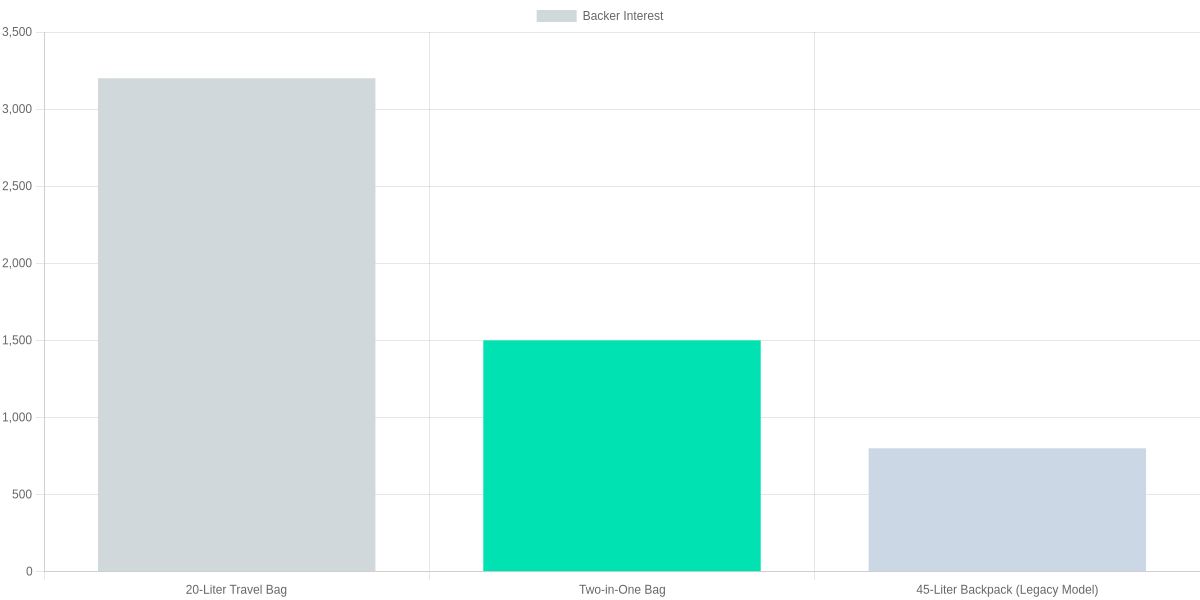
Backer interest, measured in the Kickstarter campaign, underscored the broad appeal of these new additions. The 20-liter travel bag secured the highest number of backers, signaling strong demand for a compact yet feature-rich travel solution. Meanwhile, the two-in-one bag attracted a solid supporter base, illustrating enthusiasm for innovative multi-purpose travel gear. Even the legacy 45-liter backpack continues to maintain loyal followers, reinforcing its enduring significance in Peak Design's product portfolio.
Explore Peak Design's Latest Travel Innovations
Introducing the new 20-liter travel bag, designed for versatility, packing optimization, and compatibility with camera cubes. Innovative features cater to modern travelers seeking convenience and style.
- ✓ 20-liter bag fits medium and small camera cubes
- ✓ Compact design ideal for everyday travel
- ✓ Multiple configurations for packing flexibility
- ✓ Not a replacement for the 45-liter backpack but a complementary option
The feedback during the live session also highlighted how the travel line's evolution reflects continuous design improvements from user feedback and internal testing. Each bag iteration integrates the lessons learned over years, such as enhancing zipper durability, improving strap comfort, and refining external fabric resistance to weather conditions. These incremental changes culminate in products that are robust yet refined for the adventurous traveler.
Peak Design's commitment to quality and innovation extends beyond the bags themselves, incorporating compatibility with accessories like camera cubes and packing tools. This integration not only boosts utility but also encourages users to tailor their gear setup precisely to their needs. The 20-liter bag is a prime example of this philosophy, leveraging thoughtful dimensions and thoughtful organization features to balance professional equipment transport with everyday travel demands.
Looking at the Kickstarter momentum, the bar chart below illustrates the comparative popularity of each major product in the new travel category. The 20-liter bag leads with 3,200 backers, underscoring its position as the flagship new product. The two-in-one bag follows with 1,500 supporters, while the legacy 45-liter backpack retains 800 backers, showing that the old favorite still holds value alongside the new innovative releases.
Overall, Peak Design’s travel line expansion is designed to be inclusive of various traveler types, from minimalist day-trippers to multifunctional users. The introduction of the 20-liter bag complements this philosophy by delivering a versatile, stylish, and efficient option that meets evolving travel needs in 2024 and beyond.
Design Evolution and User Experience
The evolution of Peak Design’s Travel Line Expansion reflects a meticulous and user-centric product development process. Beginning with the concept and ideation phase, the team engaged in extensive brainstorming to address the specific needs of travelers seeking versatile and efficient storage solutions. Initial sketches concentrated on form factors that balanced compactness with functionality, inspired by traveler feedback collected over the years. These early ideas laid the foundation for what would become a refined travel bag lineup.
Following ideation, the team moved into prototype development, where multiple physical versions of the bags were crafted. This stage allowed the designers to experiment with materials, dimensions, and compartment arrangements. By building these prototypes, they could evaluate the structural integrity, ergonomics, and aesthetic appeal of each variation. This hands-on process was pivotal in identifying which design elements worked best in real-world travel conditions.
Integral to Peak Design’s approach is their commitment to user testing and feedback. Selected users were given early access to the 20-liter bag and its compatible camera cube accessories. Through direct observation and user reports, the team learned how travelers packed, accessed, and carried their gear. For example, the degree of compatibility with various camera cubes provided insights critical to sizing and internal layout adjustments.
This iterative process fed into several rounds of refinement. Features such as zipper placement, strap design, and modular compartment options were tweaked to enhance both comfort and usability. Each iteration sought to balance durability with lightweight construction while ensuring that the bags catered to diverse traveling styles—from weekend trips to extended journeys.
After countless revisions, the team reached a final design approval stage. This milestone was marked by consensus across the Peak Design team, including input from senior project managers like Adrian and the social media perspectives brought by new team members such as Emma. The resulting products demonstrated well-rounded performance, attractive aesthetics, and high user satisfaction potential.
Finally, the launch of the Travel Line on Kickstarter, attracting nearly 5,000 backers, signaled robust market interest. Continuous backer engagement and community-driven feedback during the campaign mood-checked the product’s reception and guided any last-minute refinements. This ongoing dialogue exemplifies Peak Design’s dedication to embedding user experience at the core of their design philosophy.
Concept and Ideation
Initial sketches and brainstorming sessions focusing on traveler needs and versatile storage.
Prototype Development
Multiple bag prototypes created to test materials, sizes, and usability.
User Testing & Feedback
Early access provided to select users to gather real-world feedback and observe usage patterns.
Iterative Refinement
Designs refined through several rounds of tweaks to enhance functionality and comfort.
Final Design Approval
Team consensus reached on the final design balancing aesthetics, durability, and user experience.
Product Launch & Backer Engagement
Launch on Kickstarter with ongoing updates influenced by backer input and community interaction.
Two-in-One Bag vs. 45-Liter Backpack
When choosing between Peak Design's Two-in-One Bag and the 45-Liter Backpack, understanding their distinctive features and ideal usage scenarios is crucial. Both bags cater to different traveler needs and styles, offering versatile solutions but excelling in unique ways.
The Two-in-One Bag offers approximately 30 liters of capacity and shines with its convertible functionality. It can be switched easily between a backpack and a duffel, providing adaptable carrying options depending on your activity or travel style. Weighing about 2.5 pounds (1.13 kg), it is lighter and more streamlined than the 45-Liter Backpack, making it suitable for urban travel, weekend getaways, or short trips where flexibility and quick access are important.
In contrast, the 45-Liter Backpack is built for heavier loads and longer trips, offering 45 liters of storage space. Its design is more traditional, without convertible features, but with a dedicated laptop compartment and multiple external attachment points for gear. Weighing around 3.5 pounds (1.59 kg), it has a clamshell-style opening that lays flat for easy packing and unpacking, ideal for adventure travel and extended journeys that require carrying more equipment.
Functionality and Organization
The Two-in-One Bag prioritizes modular internal organization with customizable compartments and dividers. This system allows travelers to tailor the bag's interior to their specific needs, whether for camera cubes, electronics, or clothes. Plus, it has expandable side pockets and a luggage pass-through sleeve, enhancing ease of movement through airports or public transport.
Meanwhile, the 45-Liter Backpack offers fixed internal compartments designed for organization through multiple mesh pockets. It provides a reliable setup that keeps items organized but less customizable than the Two-in-One Bag. The clamshell design means the entire bag can be opened flat, which is excellent for thorough packing, especially for longer trips where gear needs to be efficiently compartmentalized.
Use Cases: When to Choose Which
Urban travelers and those who prefer versatility in their carry solutions will benefit from the Two-in-One Bag. Its convertibility between duffel and backpack modes allows for seamless transition between different environments, such as city streets, airports, or hotel lobbies. Its lighter weight and quick-access zippers make it an excellent choice for anyone needing swift access to gear or looking for a compact yet expandable bag.
On the other hand, travelers embarking on longer adventures or those requiring extensive gear capacity might lean towards the 45-Liter Backpack. Its larger volume, sturdy build, and organized compartments provide space and support for heavier loads. It is better suited for multi-day excursions, outdoor adventures, or situations where packing versatility is less critical compared to total volume and protection.
Both bags reflect Peak Design's commitment to thoughtful design and high-quality craftsmanship, but your choice depends greatly on your travel style, packing preferences, and ergonomic needs. The Two-in-One Bag offers an innovative approach to travel with its adaptable form and modular system, whereas the 45-Liter Backpack remains a stalwart for those who need traditional capacity and organization for heavier, longer journeys.
Packing Techniques with the 20-Liter Bag
Santi demonstrated practical and efficient ways to pack the 20-liter bag, emphasizing its versatility for both photographers and everyday travelers. He showcased how this compact-sized bag accommodates medium and small Peak Design camera cubes, which is ideal for organizing and protecting camera gear during travel. The cubes fit perfectly inside the bag, allowing users to separate lenses, bodies, and accessories while keeping everything easily accessible.
For travelers who want to carry more than just camera equipment, Santi illustrated packing methods for clothing and essential items. He stressed how the internal compartments and smart layout options help optimize space without causing the bag to become bulky or unbalanced. The bag’s design supports comfortable wear by distributing weight evenly, making it a practical choice for day trips or as a carry-on.
This two-step approach to packing highlights the adaptability of the 20-liter bag. Whether you are a photographer needing dedicated compartments or a traveler packing efficiently for a short trip, the bag caters to both needs with ease.
The importance of mastering these packing techniques cannot be overstated for travelers aiming to maximize space and maintain comfort. Santi’s tips also underscore Peak Design’s iterative design philosophy—constantly refining features based on real-world use to enhance user experience during travel.
Camera Cube Integration
Santi demonstrated how the 20-liter bag efficiently fits both medium and small camera cubes, allowing photographers to organize gear compactly while maintaining quick access.
- • Medium and small cubes fit perfectly
- • Allows organized separation of camera gear
- • Enhances protection during travel
Versatile Travel Packing
Santi highlighted techniques for everyday travel items like clothes and accessories, emphasizing the bag's adaptability and weight distribution for comfortable carry on trips.
- • Optimizes space for clothes and essentials
- • Maintains bag balance for ease of travel
- • Uses compartments for easy access
Interactive Q&A Highlights
Important Insight
The Live Q&A revealed how Peak Design's travel bags blend innovative design with user feedback, ensuring practical solutions for modern travelers.
A standout moment during the Q&A was when attendees asked about the compatibility of Peak Design’s 20-liter travel bag with their camera cubes. Santi demonstrated practical packing methods, confirming that both the medium and small camera cubes fit perfectly, though the extra-large does not due to size constraints. His detailed explanation helped clarify how users can optimize their setup efficiently for travel photography.
Joey Cunningham tackled questions about product evolution, notably confirming that the newly launched two-in-one bag is not designed to replace the 45-liter backpack but serves a different purpose with its modular storage and travel-focused features. He highlighted the bag’s adaptability, appealing to users who prioritize quick transitions and versatile organization over sheer volume.
Insights on Design and Prototyping
The team shared that the travel bags underwent rigorous prototyping, drawing extensively from user feedback. Pete reflected on the iterative design process, explaining how comfort, accessibility, and durability were top priorities throughout development. Adrian, the senior project manager, also contributed, detailing how his experience since 2017 has influenced the meticulous attention to detail in the product’s functionality.
Engagement with New Team Members
Emma, the Social Media Queen, chimed in on how community feedback on platforms shaped adjusted features and marketing strategies. This highlighted Peak Design’s commitment to an engaged customer base, directly feeding insights back into product refinement and campaign messaging.
Audience curiosity about Peak Design’s broader travel gear lineup sparked discussions around future expansions and the integration of camera-specific accessories with travel bags, setting expectations for upcoming releases aligned with professional and enthusiast photographers’ needs.
Frequently Asked Questions
What makes the new Peak Design travel bags stand out from previous models? ▼
Are the new travel bags compatible with older Peak Design products? ▼
What are the funding goals and current support status for the Kickstarter campaign? ▼
Conclusion
The Live Hangout: PD Kickstarter #16: Travel Line Expansion highlighted Peak Design’s dedication to innovation and user experience. Pete’s reflection on 16 years at the company underscored a journey of growth and creativity. The new travel line, featuring adaptable bags like the 20-liter model compatible with various camera cubes, showcases thoughtful design evolution tailored for modern travelers.
With nearly 5,000 backers supporting the Kickstarter campaign, enthusiasm for Peak Design’s travel bags is evident. The team’s camaraderie and expert insights during the session brought the product development story to life, strengthening community engagement and trust.
Supporting this Kickstarter means backing a brand deeply committed to quality and thoughtful design. For anyone seeking versatile, innovative travel gear, Peak Design’s latest offerings are a compelling choice.
🎯 Key Takeaways: Live Hangout Recap
- → Peak Design celebrates Pete’s 16 years with fresh perspectives on travel gear.
- → The new travel line features highly adaptable bags with thoughtful design improvements.
- → Nearly 5,000 backers show strong community support for the Kickstarter campaign.
- → The 20-liter bag integrates seamlessly with multiple camera cubes for versatile packing.
- → Peak Design’s culture shines through passionate discussions and team camaraderie.


Comments
Post a Comment